

Medically Reviewed by: Dr.Omer Sheriff, MBBS, MS (Orthopaedics), Fellowship in Joint Replacement
Years of Experience: 24+Years,
Last Reviewed: November 2026
Knee pain can make everyday activities such as walking, climbing stairs, standing and getting up from a chair increasingly difficult. Conditions such as knee osteoarthritis, age-related joint damage and previous injuries can affect knee movement and reduce quality of life. When pain continues despite appropriate treatment, consulting an experienced knee replacement surgeon can help you understand the available options.
Dr. Omer Sheriff is an Orthopaedic, Trauma and Arthroplasty Surgeon in Chennai with over 24 years of experience in orthopaedics. He has received special training at Christian Medical College (CMC), Vellore, and previously worked at Hamad Medical Corporation, Doha, Qatar. His areas of practice include trauma care and arthroplasty, including the assessment and management of joint-related conditions.
Patients experiencing persistent knee pain, stiffness or difficulty walking can consult Dr. Omer Sheriff for an orthopaedic evaluation and guidance on suitable treatment options. The recommended approach depends on the condition of the knee, medical history, symptoms and individual treatment requirements.
Meet Dr. Omer Sheriff – Orthopaedic and Knee Replacement Surgeon in Chennai
Dr. Omer Sheriff is an orthopaedic surgeon with more than 24 years of experience in the field of orthopaedics, trauma care and arthroplasty. His professional background includes specialised training at CMC Vellore and international work experience at Hamad Medical Corporation in Doha, Qatar.
He is associated with professional organisations in the field of hip and knee surgery and AO Spine Middle East, as stated in his professional profile.
His orthopaedic practice focuses on evaluating musculoskeletal conditions, joint problems and trauma-related injuries. Patients considering knee replacement can discuss their symptoms, diagnostic findings, treatment alternatives and rehabilitation requirements during a consultation.
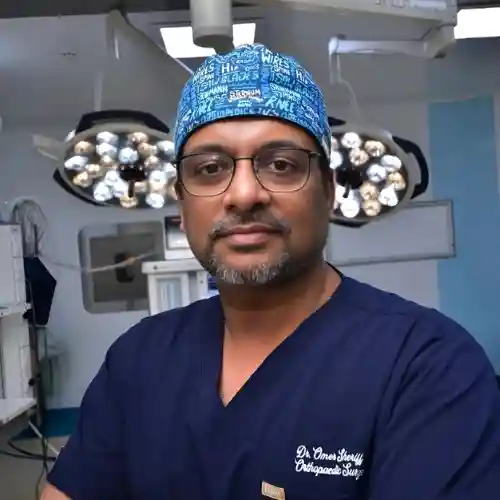
Doctor profile highlights:
- Speciality: Orthopaedics
- Areas of practice: Trauma and Arthroplasty
- Experience: 24+ years
- Special training: CMC Vellore
- Previous professional experience: Hamad Medical Corporation, Doha, Qatar
- Consultation locations: Kolathur, Nungambakkam and Royapettah, Chennai
When Should You Consult a Knee Replacement Surgeon?
Knee pain does not always mean that knee replacement surgery is necessary. Many patients initially benefit from non-surgical treatments. However, when knee pain becomes persistent and starts affecting routine activities, an orthopaedic consultation can help identify the cause and suitable treatment.
You may consider consulting a knee replacement specialist if you experience:
- Persistent knee pain while walking, standing or climbing stairs.
- Stiffness that makes bending or straightening the knee difficult.
- Swelling or discomfort around the knee joint.
- Difficulty walking for extended periods.
- Knee pain that interferes with sleep or daily activities.
- Changes in knee alignment or bowing of the legs.
- Limited improvement with prescribed medicines and physiotherapy.
Osteoarthritis is one of the common conditions associated with knee joint damage. It develops when the protective cartilage within the joint gradually wears down. This can lead to pain, stiffness and reduced movement.
A clinical assessment and appropriate imaging help the surgeon understand the extent of joint damage and determine whether non-surgical management or surgery should be considered.
What are the Different Types of Knee Replacement Surgery?
Knee replacement procedures are selected according to the affected parts of the knee, joint damage, ligament condition, alignment and the patient’s overall health.
1. Total Knee Replacement
Total knee replacement is a surgical procedure in which the damaged joint surfaces are replaced with artificial components. It may be considered for patients with advanced osteoarthritis affecting multiple compartments of the knee.
The purpose of the procedure is to reduce pain and improve knee function. Surgical planning includes evaluating joint alignment, bone condition, implant requirements and the patient’s medical fitness.
Read more about Total Knee Replacement in Chennai.
2. Partial Knee Replacement
Partial knee replacement involves replacing only the damaged compartment of the knee while preserving the healthy portions of the joint.
It may be considered for selected patients whose arthritis is limited to one compartment and whose ligaments and remaining joint structures are suitable.
Not everyone with knee arthritis is a candidate for partial replacement. The decision requires a detailed examination and imaging assessment.
Learn more about Partial Knee Replacement in Chennai.
3. Robotic-Assisted Knee Replacement
Robotic-assisted knee replacement uses computer-based planning and specialised technology to assist the surgeon during selected stages of knee replacement surgery.
Depending on the system, the technology may help with evaluating knee anatomy, planning bone preparation and assessing implant positioning.
The surgeon remains in control of the operation. Robotic assistance is not automatically better or necessary for every patient. Its suitability depends on the patient’s condition, the available technology and the surgeon’s assessment.
Patients interested in this option can learn more about Robotic Knee Replacement in Chennai.
4. Revision Knee Replacement
Revision knee replacement is a procedure that involves replacing or revising an existing knee implant when complications develop.
Possible reasons include implant loosening, wear and tear, infection, instability or certain fractures around the artificial joint.
Revision procedures can be more complex than primary knee replacement. The appropriate treatment depends on the condition of the implant, surrounding bone, soft tissues and the patient’s overall health.
Patients with an existing knee replacement who develop new pain or difficulty walking should seek an orthopaedic assessment.
How to Choose the Right Knee Replacement Surgeon in Chennai?
Choosing a knee replacement surgeon is an important step in your treatment journey. Patients should consider the surgeon’s qualifications, relevant experience, approach to treatment and ability to explain the procedure clearly.
Here are some factors to consider when selecting an orthopaedic surgeon:
1. Orthopaedic qualifications: Check the surgeon’s educational qualifications, specialist training and professional registration.
2. Relevant experience: Understand the surgeon’s experience in joint replacement and the particular procedure being considered.
3. Individual treatment planning: The surgeon should assess your symptoms, X-rays, joint condition and general health before recommending surgery.
4. Explanation of treatment choices: Ask about suitable surgical and non-surgical options, their benefits, limitations and possible risks.
5. Hospital facilities: Understand where the procedure will be performed and what surgical, anaesthesia and rehabilitation facilities are available.
6. Recovery guidance: Discuss physiotherapy, follow-up appointments and the expected rehabilitation process.
7. Clear communication: Choose a specialist who answers your questions and helps you make an informed treatment decision.
A good treatment decision should be based on medical evaluation rather than online rankings or promises of guaranteed results.
Can Knee Pain Be Treated Without Knee Replacement Surgery?
Yes. Depending on the severity and cause of knee pain, several non-surgical treatments may be considered before recommending surgery.
These may include:
- Physiotherapy to improve muscle strength and joint movement.
- Suitable exercises to maintain flexibility and mobility.
- Weight management to reduce excessive stress on the knee.
- Medicines prescribed according to the patient’s condition.
- Walking aids or supportive devices when required.
- Joint injections in selected cases.

The choice of treatment depends on the diagnosis and individual medical requirements. If these approaches do not provide sufficient relief and joint damage is significant, knee replacement may be discussed.
The decision to undergo surgery should be made after understanding the available options with an orthopaedic surgeon.
What Happens During a Knee Replacement Consultation?
A consultation helps the surgeon understand your knee symptoms and determine the next appropriate steps.
The evaluation may include:
Medical history: Discussion of your knee pain, previous injuries, existing medical conditions and treatments already tried.
Physical examination: Assessment of knee movement, swelling, stability, alignment and walking ability.
Imaging evaluation: Review of X-rays and other imaging investigations when clinically required.
Treatment discussion: Explanation of non-surgical options and whether knee replacement may be appropriate.
Surgical planning: If surgery is considered, the surgeon discusses preparation, potential risks, implant-related considerations and rehabilitation.
Not every patient requires surgery. The treatment recommendation depends on clinical findings and individual needs.
How to Prepare for Knee Replacement Surgery?
If knee replacement is recommended, preparation can help patients understand the procedure and plan for recovery.
Some important steps may include:
- Complete the medical investigations advised by the surgical team.
- Inform your doctor about existing health conditions and medications.
- Discuss diabetes, blood pressure or other medical conditions that may require attention before surgery.
- Follow the prescribed medication and fasting instructions.
- Discuss suitable exercises with your physiotherapist.
- Arrange assistance at home for the initial recovery period.
- Understand the rehabilitation and follow-up schedule.
Your surgeon and anaesthesia team will provide instructions according to your health and the planned procedure.
Recovery and Rehabilitation After Knee Replacement
Recovery after knee replacement differs between patients. Factors such as age, general health, muscle strength, the type of procedure and adherence to physiotherapy can influence progress.
Rehabilitation may include:
- Early movement: Patients may be encouraged to begin gentle movement and walking with assistance when advised by the surgical team.
- Physiotherapy: Guided exercises help improve knee flexibility, muscle strength and mobility.
- Pain management: Medicines and other recommended measures help manage post-operative discomfort.
- Walking practice: Patients gradually work towards improved walking ability with suitable support.
- Follow-up appointments: Regular reviews help the surgical team monitor healing and functional progress.
Following medical instructions and attending rehabilitation sessions are important parts of recovery. Patients should avoid comparing their progress with others because recovery timelines vary.
Why Consult Dr. Omer Sheriff for Orthopaedic and Joint Replacement Care?
Finding the right orthopaedic specialist involves understanding the doctor’s experience, treatment approach and consultation availability.
Dr. Omer Sheriff has more than 24 years of experience in orthopaedics, with areas of practice that include trauma care and arthroplasty. His special training at CMC Vellore and previous experience at Hamad Medical Corporation, Doha, Qatar, form part of his professional background.
Patients experiencing persistent knee pain, stiffness, mobility difficulties or joint-related problems can consult him for an assessment and discussion of suitable treatment options.
His consultation locations across Chennai allow patients from different parts of the city to enquire about appointment availability.
Knee Replacement Consultation Locations in Chennai
Dr. Omer Sheriff consults at the following hospital locations in Chennai. Patients can contact the appointment team to confirm consultation timings and availability before visiting.
Patients looking for a knee replacement surgeon in Royapettah can visit Orthomed Hospital, Royapettah. Those searching for a knee replacement surgeon in Nungambakkam can consult at Vinita Hospital, Nungambakkam. Patients from nearby areas can also visit Meridian Hospital for consultation.
For patients searching online for a knee replacement surgeon in T. Nagar, Vinita Hospital in Nungambakkam may be a convenient nearby consultation location.
Meridian Hospital – Kolathur
Address: 46D, Jawaharlal Nehru Road, 200 Feet Ring Road, Kolathur, Chennai, Tamil Nadu – 600099.
Patients from Kolathur and nearby areas can enquire about an orthopaedic consultation for knee pain, arthritis-related symptoms and joint problems.
Vinita Hospital – Nungambakkam
Address: No. 70, Josier Street, Tirumurthy Nagar, Nungambakkam, Chennai, Tamil Nadu – 600034.
Patients in Nungambakkam and surrounding localities can enquire about consultation availability for orthopaedic evaluation and knee-related conditions.
Orthomed Hospital – Royapettah
Address: New No. 85, Royapettah High Road, Royapettah, Chennai – 600014.
Patients from Royapettah and nearby areas can enquire about an appointment to discuss persistent knee pain and available treatment options.
Book an Orthopaedic Consultation in Chennai
Persistent knee pain and restricted movement should not be ignored. An appropriate orthopaedic assessment can help identify the cause of your symptoms and explain the available treatment options.
If you are looking for a knee replacement surgeon in Chennai, you can consult Dr. Omer Sheriff to discuss your knee condition, understand suitable treatment choices and plan the next steps.
Book your consultation today.


